Showing posts with label digital. Show all posts

Using Arduino on industrial digital printing machines

on Friday, July 5, 2013

Arduino goes industrial

Most of the projects we’ve been featuring on this blog are  happen to be focused on diy approaches around music, design, art. We are  noticing that more and more people are starting to realize the benefits of using Arduino also in  industrial settings.

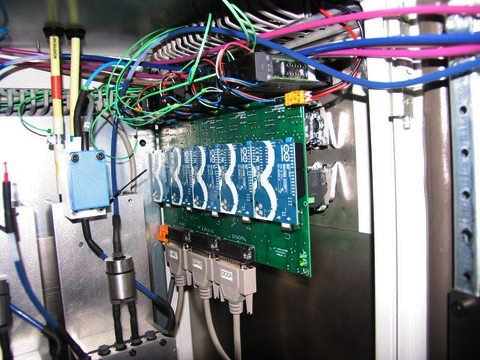
Today I’m going to highlight a project posted by Paul M Furley on his blog and describing how back in 2009 he worked in a  family firm, producing the user operator software for their new digital printing machine and decided to use Arduino in high-tech manufacturing:

 I’d been hacking around with Arduino since my masters project and it came along at a perfect time for JF Machines. They had just developed their new ink circulation system: a serious affair with 5 separate ink bottles rising and falling to alter  pressure along with precise temperature control. They needed a way to drive the bottle lifting motors, read in alarm signals and switch inputs as well as output various flashing sequences for the benefit of the operator. Although a PLC would have been suitable, Arduino seemed like a great option.

Since then he realized why he made the right choice  and lists a number of the reasons useful to explore.

You can read the complete story on  his page, here’s just a couple of the most interesting benefits:

Supply security – even if Arduino stopped supplying boards tomorrow, other manufacturers are making clones, and the hardware design lives on. If Arduino changed their physical design, it wouldn’t be much trouble to make a converter to adapt the new and old sockets – in fact, someone would probably release it was an off-the-shelf project as soon as the announcement was made! In the worst case scenario, JF Machines could manufacture the whole Arduino board from the designs for as long as the a compatible microcontroller remained available.

Low cost – I often hear the opposite argument when discussing Arduino with the hobby and hacker scene. I agree that for integrating into a consumer product, the Arduino’s off-the-shelf price is fairly expensive (although good luck designing and making a small batch yourself for cheaper…). However when integrated in a five-figure industrial printing machine, the cost comes close to zero, especially when considering the PLC alternative and the support benefits. If JF Machines were ever to mass-produce their machines, reducing the price of the Arduino would be fairly low on the list of priorities!

picocolour

If you have a similar story and want to share it, we’d be happy to feature it on the blog,  just submit it on this page.


View the Original article
Tinkering and coding with teens for a future of digital making

on Sunday, March 24, 2013

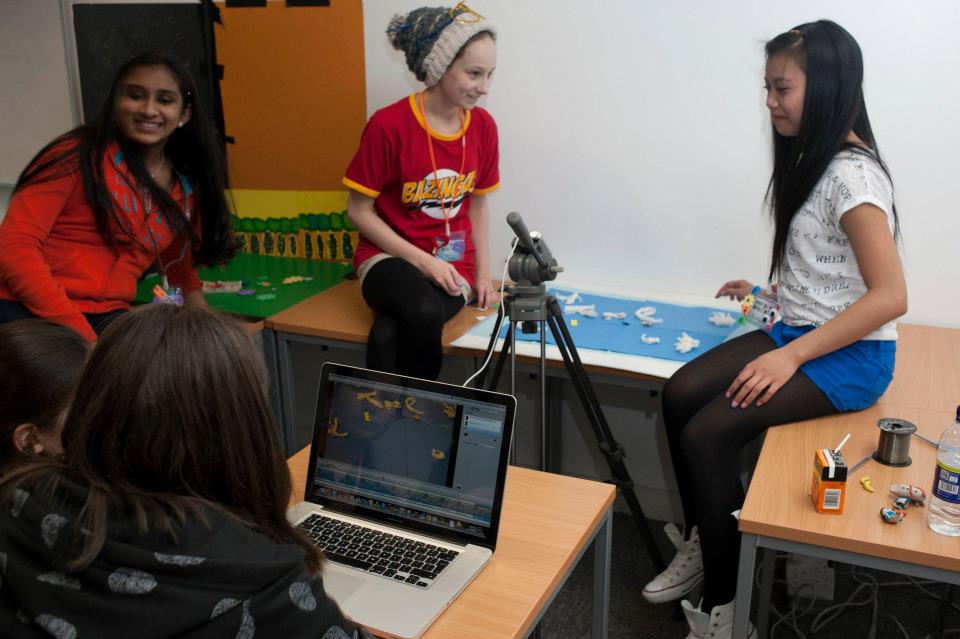
one day digital Pic by Alan Richardson Dundee, Pix-AR.co.uk

At the beginning of march Christopher Martin, researcher in applied computer,  wrote us an email to tell us that he got involved in an ambitious plan taking place:  100 school pupils, 5 different digital-maker themes in 1 day for 4 subsequent weeks across Scotland.

The event called “One Day Digital” started on the 2nd of March at the Dundee University, where he is based,  and is organized by Nesta, supported by the Nominet Trust, O2 Think Big and the Scottish Government which created it as part of a wider programme called “Digital Makers” . It is especially aimed at:

encourage and enable a generation of young people to create, rather than simply consume, technology. Working closely with a consortium of partners, we are launching a campaign to highlight the benefits of learning digital skills and encourage innovation in digital education to equip young people with the skills they need to thrive in the digital world.

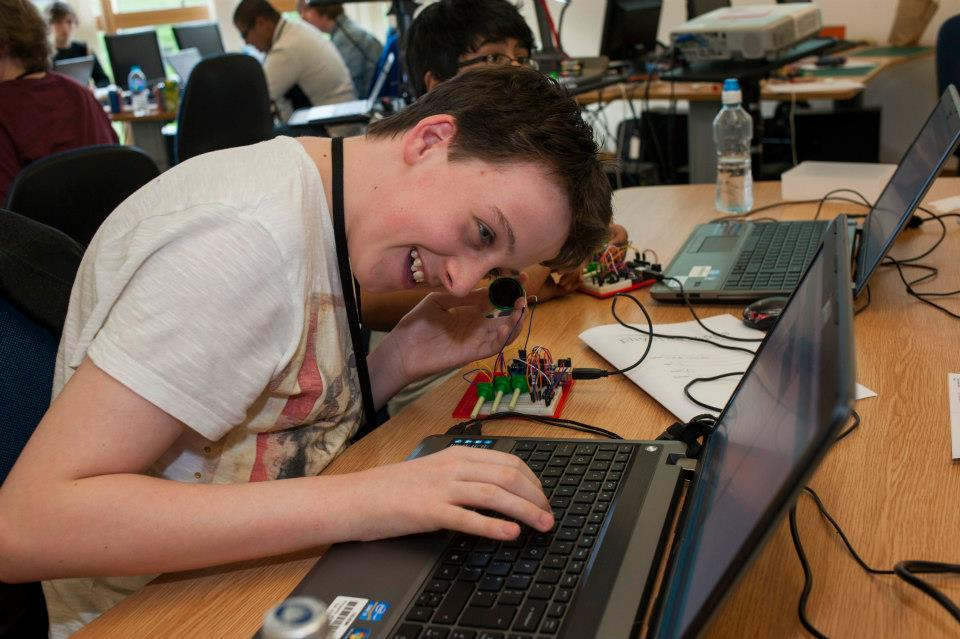
one day digital Pic by Alan Richardson Dundee, Pix-AR.co.uk

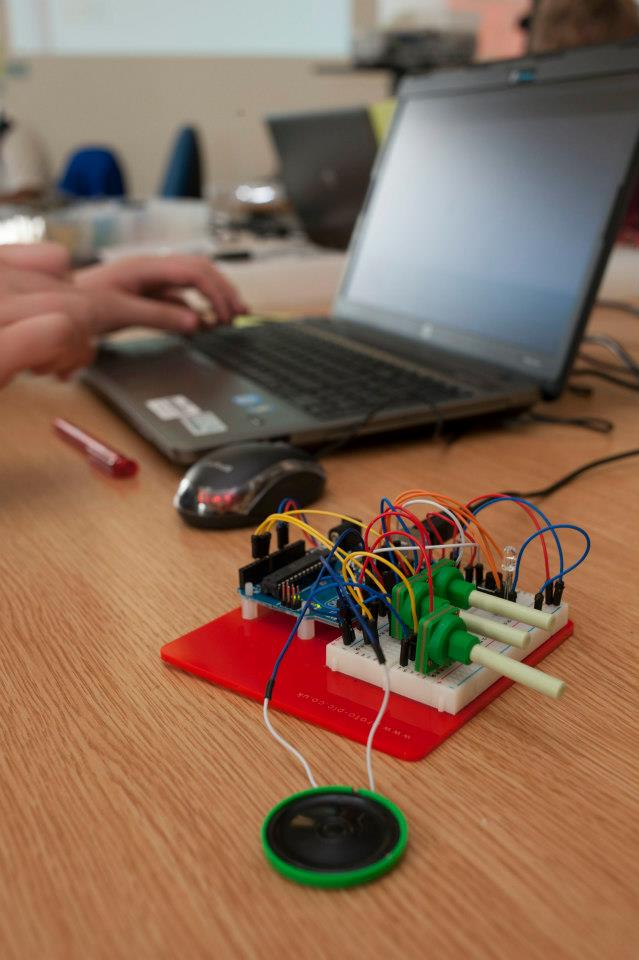
Chris  was running the Arduino session supporting  12 students (age 13/14) on their first steps with C programming and some bread boarding with Arduino UNO.  He wrote on his blog:

After a fairly intense 2 hours or so lights had flashed, dials had been turned and various coding techniques learned. It was really interesting to see how quickly the loose association of school pupils came together as a team, eagerly helping each other when they could. After a well earned lunch we moved on to some more output modes and looked at writing functions to control an RGB LED and used a bunch of variable resistors to make a colour mixer. I think the highlight was the getting the speaker to play different tones, controlling the pitch with one variable resistor and the timing with the other. Quite eerily the air was full of monotonic blips and beeps like a room of R2D2s.

The format of the Arduino session worked like this: a morning of coding and breadboarding and then an afternoon busy on building some “physicalApp” to make something they care about. The term physicalApp is a cool concept coined by Jon Rogers  and pulls together a multitude of physical computing project hackery.

One of the neat app ideas that came up was a drawing machine based on what a knitting needle is doing: the prototype is just using random servo position (rather than accelerometer data) and you need to feed paper under it by hand.

It’s great to see teens getting involved and inspired by tinkering and coding. If you are interested in attending one of their two upcoming events (23rd and 30th of March) click here,  or keep receiving info about ongoing activities  from Facebook.

one day digital


View the Original article