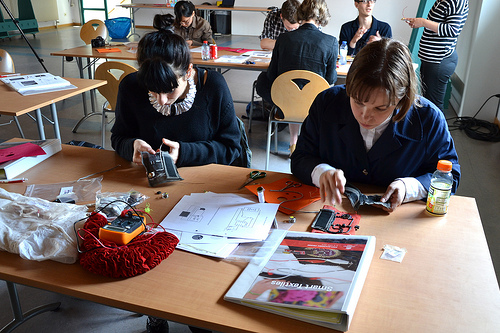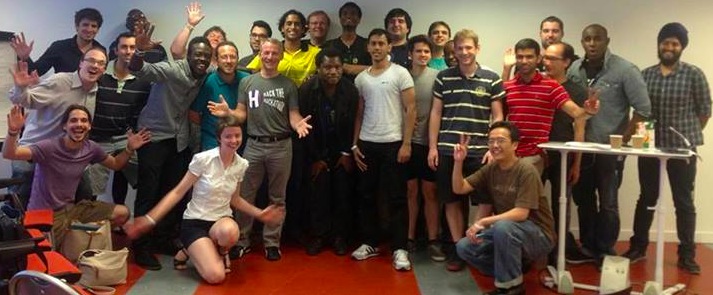
At the beginning of July Arduino was in London to participate to Hack The Hackathon event. We had a great time and a lot of enthusiasm about Arduino: at least 60 hands went in the air when Russ Klein, from HTH, asked on Friday night who had never seen Arduino. And by the end of the weekend, 5 projects were developed using the technology and 26 people emerged with hands-on experience. Here’s a summary of the projects and some pictures:
MEDITEL
Katie Bibbard, Edwin Senjobe, Duncan McKenzie, and Julian Carstairs created a method for rural healthcare workers in Africa to monitor and report a patient’s vital signs, diagnose the patient’s condition, and take appropriate action. A portal allows the readings to be communicated to experts in other locations who provide advice and guidance. Arduino and GSM Shield were used to collect physical data and upload via USSD or SMS but also program reminders to deliver medicines. This is their presentation on Prezi.
ICE BUDDY – AID CONVOY
Hoi Lam created a local communications system to be used when there is a report of disaster. The system sends the coordinates to users of local team within a specified radius then asks, “are u ok?” Arduino makes the system easy to use for small teams of people (for example a United Nations Convoy) which may not be able to communicate with the outside world but which can communicate locally among team members. Arduino provides visible cues to help rescue and reconnaissance workers coordinate efforts.
PEPITA
Alex Gonzalez, Carlos Miguel, and Gianfranco Cecconoi created an inexpensive device that functions as a remote control unit to help elderly and learning disabled people access basic communications functions without having to learn a complex system of menus and other user interface options. Arduino is the controller giving support technicians a reduced set of possible issues, fewer distracting features, and fewer ways that the end user can get lost or confused.
SAFE @ HOME
Matthias Buchting created a way to detect critical injury at home. Elderly or infirmed people living on their own sometimes suffer catastrophic injury and cannot call for help. Using Arduino and sensors such as temperature for fire, sensors at the door to see if a person is walking in apartment, motion and sound to detect the absence of movement, abnormal readings can be sent as notifications to healthcare or emergency response personnel.
SMARTWELL
The team composed by Omkar Vadpathak, Munya Mutikani, Thura Z Maung, and Javier Madrigal worked on a project that tests well water in rural areas of India and Africa. Water wells are far apart and regular testing is difficult or impossible in many areas.
Before going to the well, user can send an SMS to request info and the well answers back delivering some environmental parameters and, most importantly, if there is water and if it’s drinking water. Arduino is able to measures the temperature, water level, toxicity, oxygen content, and other vital readings to determine whether the water is safe to drink. All the wells are sending info to authorities allowing them to monitor the level of pollution and understand if reclamation is needed.
HAPPY CYCLE
Javier Madrigal created a sensor-based safety system for use by bicyclists. Using proximity and other sensors, a cyclist is alerted of approaching vehicles and other obstacles. Arduino acts as the data collection device and communicates with the cyclist’s phone or other audio or visual warning system. The system focuses on blind spots, darkness, and other cycling hazards.
View the Original article