Bleuette, the hexapod robot

on Sunday, March 24, 2013

bleuette hexapod robot

Bleuette project is hexapod robot equipped with 6 legs that can be operated without any external guidance.

The french project is fully open hardware (made entirely with  an Ultimaker 3D printer) / opensource and operates on a Arduino Leonardo board with a custom shield developed for it and available on Hugo’s website, the author of the project. It is used mostly to control the 12 servos (+ 2 optional) for the legs, measure voltage and current.

Take a look at the robot’s first steps!


Hugo is also thinking about future developments for Bleuette, like equipping it with a Bluetooth connection, a magnetic sensor to keep an edge when walking and finally a mobile turret with an ultrasonic sensor to detect obstacles in front of it.

Interested in the code? you can find it on Github:


View the Original article

Make a voice call with Arduino Gsm Shield & more examples!

on

Arduino Gsm Shield

Some days ago we launched our new product, the Arduino Gsm Shield, together with an intro video explaining how to make the first steps into the creation of interaction with it.
Today we’re publishing another video with a second step-by-step tutorial by David:

And we want to share some more because last year at the Malmo University K3 during the second year in Interaction Design BA, David Cuartielles and Tony Olsson run a course where students had to work on a project with state of the art of technology using wireless communication as a main mode of operation.

As one of the tools, 30 students could experiment with early prototypes of the GSM shield  and they came out with different projects and ideas.  Here you can see one of the proposals that made it to the finals at a M2M contest arranged in Sweden by Tele2.

  • “Personal Safety” By: Cathrin Malmqvist & Karin Danielsson


We wanted to re-design the weareble safety alarms to make them more smooth, mobile and invisible. The idea is to apply the features of the safety alarm to something familiar like your watch or bracelet. The prototype is built with Arduino with a GSM-shield, an accelerometer, speakers and a microphone

Concept:

Working prototype:


View the Original article

Tinkering and coding with teens for a future of digital making

on

one day digital Pic by Alan Richardson Dundee, Pix-AR.co.uk

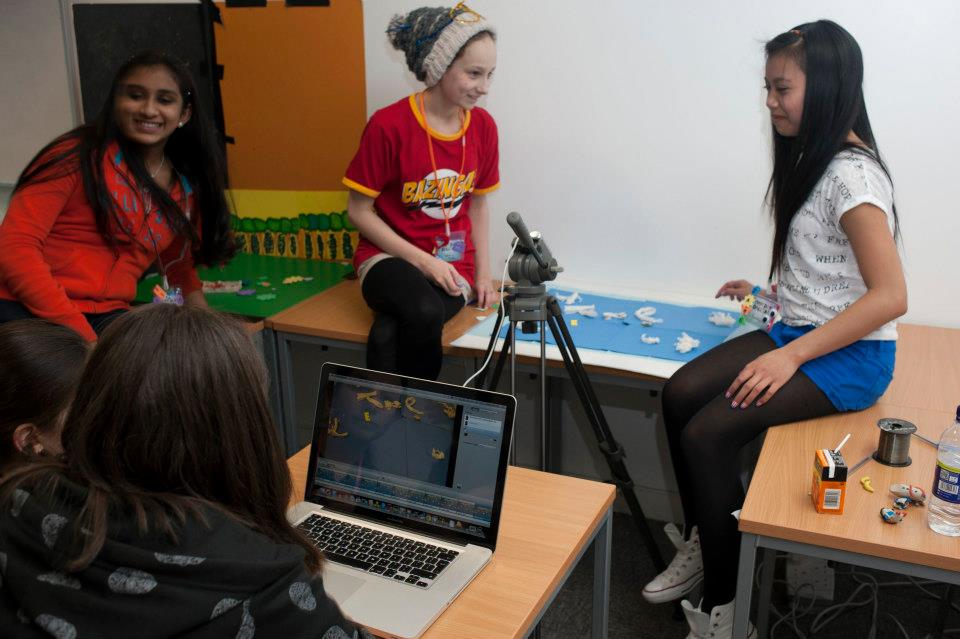
At the beginning of march Christopher Martin, researcher in applied computer,  wrote us an email to tell us that he got involved in an ambitious plan taking place:  100 school pupils, 5 different digital-maker themes in 1 day for 4 subsequent weeks across Scotland.

The event called “One Day Digital” started on the 2nd of March at the Dundee University, where he is based,  and is organized by Nesta, supported by the Nominet Trust, O2 Think Big and the Scottish Government which created it as part of a wider programme called “Digital Makers” . It is especially aimed at:

encourage and enable a generation of young people to create, rather than simply consume, technology. Working closely with a consortium of partners, we are launching a campaign to highlight the benefits of learning digital skills and encourage innovation in digital education to equip young people with the skills they need to thrive in the digital world.

one day digital Pic by Alan Richardson Dundee, Pix-AR.co.uk

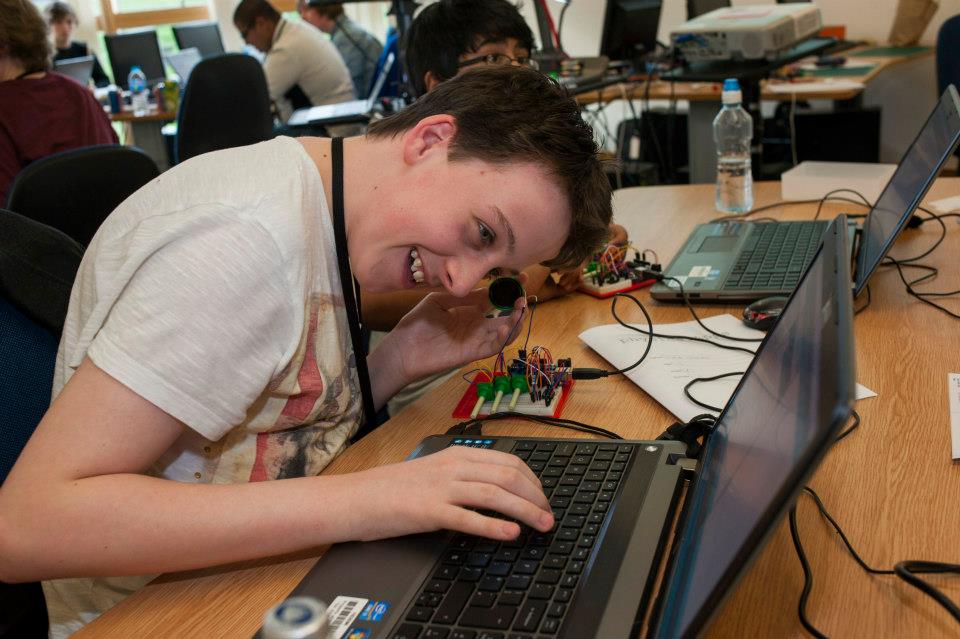
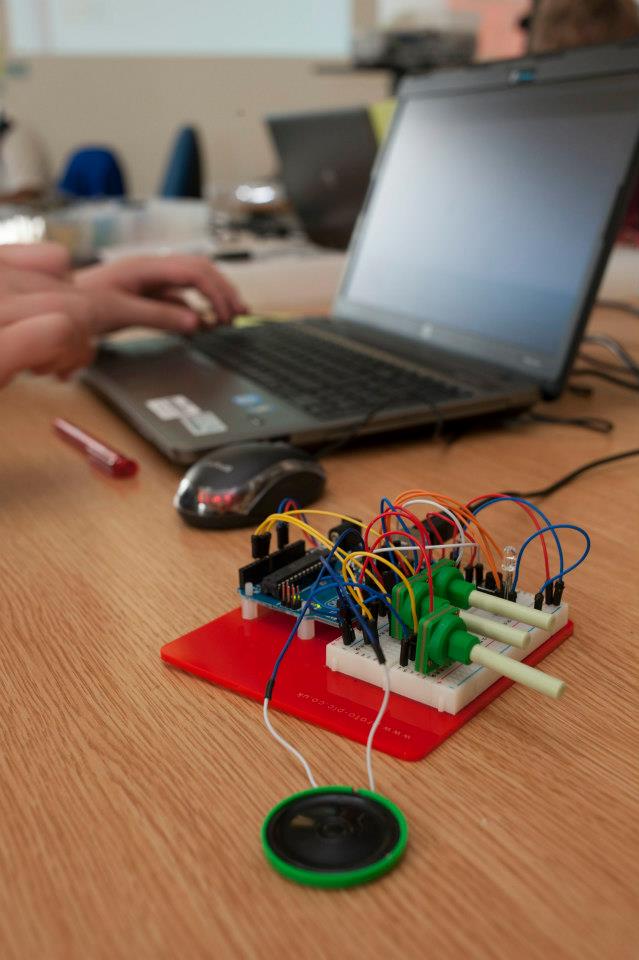
Chris  was running the Arduino session supporting  12 students (age 13/14) on their first steps with C programming and some bread boarding with Arduino UNO.  He wrote on his blog:

After a fairly intense 2 hours or so lights had flashed, dials had been turned and various coding techniques learned. It was really interesting to see how quickly the loose association of school pupils came together as a team, eagerly helping each other when they could. After a well earned lunch we moved on to some more output modes and looked at writing functions to control an RGB LED and used a bunch of variable resistors to make a colour mixer. I think the highlight was the getting the speaker to play different tones, controlling the pitch with one variable resistor and the timing with the other. Quite eerily the air was full of monotonic blips and beeps like a room of R2D2s.

The format of the Arduino session worked like this: a morning of coding and breadboarding and then an afternoon busy on building some “physicalApp” to make something they care about. The term physicalApp is a cool concept coined by Jon Rogers  and pulls together a multitude of physical computing project hackery.

One of the neat app ideas that came up was a drawing machine based on what a knitting needle is doing: the prototype is just using random servo position (rather than accelerometer data) and you need to feed paper under it by hand.

It’s great to see teens getting involved and inspired by tinkering and coding. If you are interested in attending one of their two upcoming events (23rd and 30th of March) click here,  or keep receiving info about ongoing activities  from Facebook.

one day digital


View the Original article

Something is rotten in Denmark (Bio-Hacks)

on

Labitat, 3/2013

Massimo and I had the chance to visit a Labitat makerspace in Copenhagen. I have to thank Martin Markus to let us in on a non-visit day and move underground, where the lab is.

The main reason of our visit was getting in touch with the Bio-Hackers and Maker Community meeting there, get them involved in the Call of Makers for the upcoming European Maker Faire in Rome. We had a good time in talking with them about the strange situation we are witnessing here in Europe: many languages, many nations, one big movement of people tinkering around stuff. Get everybody to know about this event and the chance to meet and talk to each other is a massive task. But we are going to overcome it!

Labitat, 3/2013

The place is just super. I’ve been involved in the making of a makespaces in the last three years of my life, but I have no words in describing the feelings I had in witnessing the massive amount of contents that basement kept. No joke.

I tried my best in recovering those objects, those feelings and this odd XXIst century knowledge in a pool set of Flickr, where I tried to describe and follow the different projects I’ve seen.

Why visiting makerspaces is to me just like standing on giants shoulders? Basically because I know the problems and I see better, streamlined solutions answering (better than ours in Fablab Torino. You guys feel free to comment and make me feel naiv about the Fridge,  Bio Hacks, the communication billboards, and the AtMEGA 16u2 hack from Dennis.


View the Original article

Dive into the Internet-of-Things world with the new Arduino GSM Shield

on Sunday, March 17, 2013

Arduino Gsm Shield

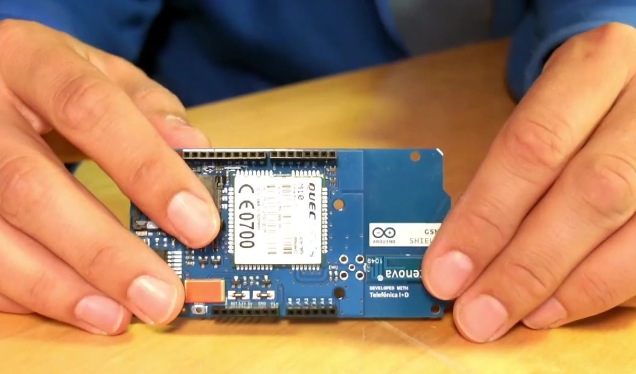
We are excited to announce that the new Arduino GSM Shield is ready to be shipped allowing Arduino boards (Uno, MEGA and Leonardo) to explore the wonders of adding a GPRS/GSM connection to interactive projects.

We teamed up with Telefónica Digital to design a tool that is greatly simplifying the process of building Internet of Things applications based on the GSM mobile phone network and controlled through the internet anywhere there is mobile phone coverage.

Every shield is equipped with a SIM card ready to be plugged in and used within a special worldwide data tariff especially created for the product by Telefónica but you can use any SIM from other providers.
As you can see from the video above, the activation process is really simple and fast through the BlueVia website where you can login with your Arduino account and be online in minutes!

Then you can easily implement features like
- make/receive calls: plug a sound speaker at the connector at the bottom of your shield and you can get your board to play the sound while you make/receive voice calls.
- send/receive SMS: when a sensor reaches a threshold your Arduino can text any number or remotely activate a device.

If you want to hear more about the GSM Shield directly from David Cuartielles, have a look at this video:

You can put your hands on the new Arduino GSM Shield from today directly from our store and from the 25th of March also from all the other distributors.

Follow us on Facebook, Twitter and G+ and when you create something great with it, don’t forget to share it with us: submit your project here.

————————————-

Share the news with these Hashtags: #gsmshield #arduino

Take a look at the pics:


View the Original article

A thermometer of future temps with the Arduino GSM Shield

on

thermometer

Things you can do with the new Arduino Gsm Shield: a thermometer of future temps!


View the Original article

Let’s go creative with lighting on a DIY laser device

on

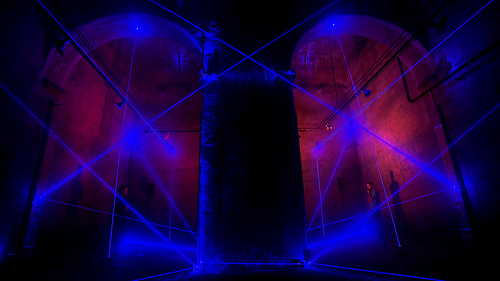
blaus lasershow

Last year MediaInteractiveDesign and PlayModes , two interactive design and creative technology studios based in Catalonia, collaborated to develop a system to control DIY Laser robot.

They created a new shield  to control Dinamyxel servomotors  to work with PWM laser drivers. The shield works using Arduino Ethernet programmed with a specific firmware to control laser and motor using Open Sound Control.

The project involved a team of 3 people (Eloi Maduell, Alex Posada and Santi Vilanova) coming from the field of audiovisual creativity, hardware engineering and software development.

To show us the way this system can be used, they sent us two of their projects. Enjoy!

A visit to the Arduino factory on DomusWeb

on

Arduino Factory

The entire manufacturing process (except for certain purchased components) [of Arduino boards] takes place in and around Strambino, Ivrea, in a context dominated by the small- and medium-sized companies that are typical of Italian industrial districts and of the “Made in Italy” phenomenon itself.

Ivrea’s history is another interesting part of the picture. The city was intimately tied to the presence of Olivetti, a company with a legacy of incredible electronics know-how, and an entire generation of experts. In fact, the Interaction Design Institute was established in a former Olivetti building randomly covered with blue tiles — just like the Arduino boards. The company still exists as a brand, but it is no longer involved in design and development. If Olivetti had not been there before, maybe Arduino would not exist today.

This is an extract from an article by Alice Mela and published today on DomusWeb.


View the Original article