Updating about Arduino Yún (video preview!) and Arduino Robot

on Monday, August 26, 2013

Arduino Yún - Unboxing

Some months ago we announced that we were developing a new product to meet the growing demand for wi-fi, linux based boards. The blogpost on the upcoming Arduino YÚN was our most read ever, and since then the attention has stayed high.

Recently, some of you have been asking why the YÚN hasn’t come out yet and why the Arduino Robot is not yet available for purchase.

Simply put, moving to a wifi-enabled linux board is a whole new step for Arduino and it’s taking longer than we expected. Arduino YÚN  is our most complex product ever and we decided to working on getting it right regardless of timing.

The early prototypes boards mounted 8MB of Flash and 32MB of RAM. While we managed to implement most of the YÚN features previously planned inside this amount of memory, we were forced to use optimized versions of the most common software packages: smaller in size but missing a lot of cool features available in the “full” non-optimized version.

We also quickly discovered that there wasn’t plenty of free space remaining for the user to install additional packages or to run complex programs without incurring in stability problems.

Considering this we finally decided to double both Flash and RAM, giving a comfortable 16MB of Flash and 64MB of RAM.

We try our best to get everything done as soon as possible while still providing the quality that we hope distinguishes Arduino products.

The delay in the Arduino Robot is connected to that of YÚN and our distribution processes.

We are really happy about the new Arduino YÚN and we hope the community will be as well.

The board is going to be available on the Arduino Store from September the 10th, while being delivered to our distributors late this month. In the video below you can watch a  preview of the board with me and David Cuartielles giving some more details about it.

From the product pages on the Arduino Store,  for the YÚN and Robot, you can activate an alert that will send you an email when the product is available from the distributors.


View the Original article

ArduSat successfully launched in space – Watch video!

on Monday, August 12, 2013

ardusat launch

ArduSat was successfully launched in space last Sunday 4th August and it’s now on its way to the International Space Station (ISS):

Ardusat is the first open satellite platform allowing general public to design and run their own applications, games and experiments in space, and also steer the onboard cameras to take pictures on-demand:

Ardusat offers the chance for everyday people to control a satellite for different purposes such as exploration, entertainment and experiments. It takes advantage of the existing technologies and platforms so that more and more people can participate in the space technology. With more and more people participating, the space industry is likely to go on through countless innovations.

Learn more from DIY Space Explorations.


View the Original article

My open-source, do-it-yourself cellphone (built with Arduino).

on

DIY cellphone (in hand)

For a little over a year, I’ve been working on an open-source, DIY cellphone as part of my PhD research at the MIT Media Lab. The current version of the phone is based on the Arduino GSM shield and Arduino GSM library. It sports a deliberately low-resolution screen (8 characters, each a 5×7 matrix of LEDs), a laser-cut wooden enclosure, flexure (living hinge) buttons, and a ~1000-line Arduino program that powers the user interface. The phone can make and receive phone calls and text messages, includes a phone book and caller id, and keeps the time. Everything you’d expect from a 20-year old Nokia! (Except snake.) I’ve been using various iterations of the project as my primary cellphone for the past six months or so.

DIY Cellphone (LED matrix variant)DIY Cellphone (LED matrix variant)

The phone is open-source and the design files are available on GitHub (hardware, software). Assembly instructions are on my website, although I wouldn’t recommend making your own unless you have experience with soldering surface mount components.

Second DIY cellphone workshop

Of course, it’s not just me that’s been building these phones. I’ve run two workshops in which other people have made them for themselves. A few people have been building them on their own, including someone who posted his result on Twitter.

Ben Peters' Phone.Dena's purpleheart phoneNadya and Jeff making cellphones

Here you can see some the variations on the enclosure that my friends have made. On the left is a 3d-printed case by Ben Peters, the middle is a CNC-milled purpleheart wood case by Dena Molnar, and on the right is a hand-cut cardboard case by Jeffrey Warren.

DIY Cellphone Prototypes

The phone has undergone numerous revisions as I’ve tried to get it into a robust, useable form. Here you can see some of those variations. I started with an LCD screen like those found on old Nokia phones, but it would break after a month or so in my pocket, so I switched to the more-robust LED matrix. The enclosure has had a few tweaks as well, primarily to find a good design for the flexure buttons.

DIY Cellphone (LED matrix variant)

Overall, I’m pretty happy with the current incarnation. It seems to be relatively robust, simple enough to assemble by hand, and functional enough to use everyday (although a long way from a smart phone). That’s my DIY cellphone.


View the Original article

Fueling the Hardware Revolution with Tindie

on Thursday, August 1, 2013

Tindie

Some people call it the “Etsy for hardware”, some other “the indie marketplace for open source hardware”, even if being open is not a requirement. Tindie’s mission consists of connecting the world’s small, hardware businesses with customers all over the world and today starts a cool initiative called Open Designs and Kickbacks. When sellers create a new product, they will be able to select a project the product is a derivative from, and enter the % of sales that will go to the open hardware project.

“Businesses can manufacture the open design as is, or create products derived from it. Those sellers can then kickback a portion of their sales back to the designer. Tindie will handle the disbursement of funds so it’s absolutely painless. For designers, there are no fees, no hosting costs, just a simple way to reap the benefits of their hard work”

Some weeks ago Arduino announced in a blogpost about donating every year to projects which are part of the open source ecosystem because we are grateful to these efforts and want to support them and now we are happy to announce of being Tindie’s first partner in the Open Designs’ initiative.   Businesses that have built on top of Arduino boards can now send a portion of their sales back to Arduino, and help us further growing our efforts in supporting the open source community. Take a look at the products derived from Arduino.

For more info and insights, take a look at the Tindie’s website.


View the Original article

Some notes from Hack the Hackathon London

on Tuesday, July 30, 2013

HacktheHackathon-London2013

At the beginning of July Arduino was in London to participate to Hack The Hackathon event. We had a great time and a lot of enthusiasm about Arduino: at least 60 hands went in the air when Russ Klein, from HTH,  asked on Friday night who had never seen Arduino. And by the end of the weekend, 5 projects were developed using the technology and 26 people emerged with hands-on experience. Here’s a summary of the projects and some pictures:

MEDITEL
Katie Bibbard, Edwin Senjobe, Duncan McKenzie, and Julian Carstairs created a method for rural healthcare workers in Africa to monitor and report a patient’s vital signs, diagnose the patient’s condition, and take appropriate action. A portal allows the readings to be communicated to experts in other locations who provide advice and guidance. Arduino and GSM Shield were used to collect physical data and upload via USSD or SMS but also program reminders to deliver medicines. This is their presentation on Prezi.

ICE BUDDY – AID CONVOY
Hoi Lam created a local communications system to be used when there is a report of disaster. The system sends the coordinates to users of local team within a specified radius then asks, “are u ok?” Arduino makes the system easy to use for small teams of people (for example a United Nations Convoy) which may not be able to communicate with the outside world but which can communicate locally among team members. Arduino provides visible cues to help rescue and reconnaissance workers coordinate efforts.

PEPITA
Alex Gonzalez, Carlos Miguel, and Gianfranco Cecconoi created an inexpensive device that functions as a remote control unit to help elderly and learning disabled people access basic communications functions without having to learn a complex system of menus and other user interface options. Arduino is the controller giving support technicians a reduced set of possible issues, fewer distracting features, and fewer ways that the end user can get lost or confused.

SAFE @ HOME
Matthias Buchting created a way to detect critical injury at home. Elderly or infirmed people living on their own sometimes suffer catastrophic injury and cannot call for help. Using Arduino and sensors such as temperature for fire, sensors at the door to see if a person is walking in apartment, motion and sound to detect the absence of movement, abnormal readings can be sent as notifications to healthcare or emergency response personnel.

SMARTWELL
The team composed by Omkar Vadpathak, Munya Mutikani, Thura Z Maung, and Javier Madrigal worked on a project that tests well water in rural areas of India and Africa. Water wells are far apart and regular testing is difficult or impossible in many areas.
Before going to the well, user can send an SMS to request info and the well answers back delivering some environmental parameters and, most importantly, if there is water and if it’s drinking water. Arduino is able to measures the temperature, water level, toxicity, oxygen content, and other vital readings to determine whether the water is safe to drink. All the wells are sending info to authorities allowing them to monitor the level of pollution and understand if reclamation is needed.

HAPPY CYCLE
Javier Madrigal created a sensor-based safety system for use by bicyclists. Using proximity and other sensors, a cyclist is alerted of approaching vehicles and other obstacles. Arduino acts as the data collection device and communicates with the cyclist’s phone or other audio or visual warning system. The system focuses on blind spots, darkness, and other cycling hazards.


View the Original article
Take the 2013 Open Source Hardware Community Survey.

on

Catarina Mota and I put together an updated version of the annual Open Source Hardware Community Survey for the Open-Source Hardware Association (OSHWA). Here’s a summary:

Our goal is to arrive at a better understanding of who we are as a community, why and how we use/make open-source hardware, and how our practices and numbers are changing over time. For this purpose, we are asking all those who use and/or develop open-source hardware to please respond. The aggregate results will be made publicly available after the survey closes. By publishing your responses, we hope to provide the public with insights into the practices and experiences of the people involved in open-source hardware.

Please help us understand the open-source hardware community by taking the survey.

You can also check out last year’s results.


View the Original article

Arduino Starter Kit video tutorials now released in Creative Commons

on

StarterKitVideotutorial

Last year to celebrate the launch of the new Arduino Starter Kit,  RS Components in collaboration with Arduino,  produced  10 video tutorials featuring Massimo Banzi showing how to create cool projects with the redesigned release of the Kit and all its components.
 

Today RS Components announced on their Twitter and Google+ that the Arduino video tutorials are now marked with a Creative Commons license, that means that you can remix and reuse them as you like.

We created a Playlist on Arduino official Channel and soon we’ll add also German and French subtitles.


View the Original article

A Neonatal Baby Monitor goes open source and collaborative in Kenya

on Friday, July 26, 2013

OpenBabyMonitorTeam

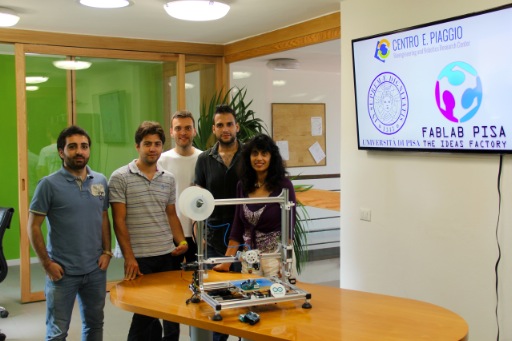
On the 11th of August a team composed by researchers from FabLab Pisa and University of Pisa’s Center for Bioengineering and Robotics “E.Piaggio” will start a great adventure with a Summer School on the project called OS4BME (Open Source for Biomedical Engineering).

The aim of the project is to bring the DIY&Makers approach in the developing of simple, low cost/high impact biomedical devices, precisely, in this particular case, a neonatal Baby Monitor.

The course will take place at Kenyatta University (Nairobi) and it will involve setting up a 3D printing system, developing a neonatal monitoring device, using open source, electronics based on the Arduino platform and powered by solar panels.

Participants will play an active role in the identification of components, design, assembling and testing of the device and in the discussion of regulatory issues in its development. Close attention will also be paid to safety, ergonomic aspects and regulatory  standards for biomedical devices.

The medical device industry in Africa is largely absent and there is an over reliance on foreign companies to repair and design biomedical instrumentation and resolve technical problems … More importantly, at present there are no specific engines or platforms focused on the sharing of biomedical instrumentation and devices. This is because, by their very nature, biomedical devices possess stringent performance requirements to comply with regulatory standards to ensure patient safety.

OS4BME is a project created by Prof. Arti Ahluwalia (Univ. Pisa), Daniele Mazzei and Carmelo De Maria (both from Fablab Pisa but also post-doc researchers at Centro E.Piaggio). The summer school is an initiative organized by a consortium of nine African universities with the objective of creating a sustainable health-care system, developing a network of academic excellence for Biomedical Engineering in Africa with the support of the ‘United Nations Economic Commission for Africa (UNECA).

 Arduino is supporting the project and  we sent to the team a bunch of Arduino UNO boards, Wi-Fi and GSM Shields to be used during the course and then will be donated to the Kenyatta University and Fablab Nairobi.

Arduino Package

In the next week  we’ll keep in touch with the team and receive updates directly from the summer school. Stay Tuned on this blog and on the work in progress of their WIKI!


View the Original article