Vi aspettiamo all’Arduino Day a Roma

on Sunday, April 7, 2013

arduino day 2013

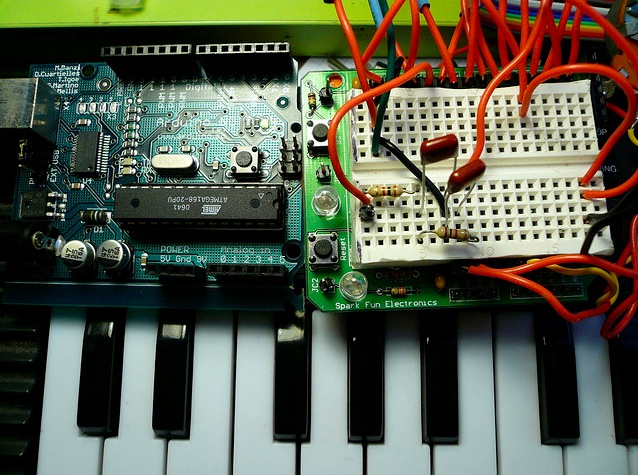
Sabato 6 aprile 2013 si tiene a Roma, l’Arduino Day – Think Make Share. Si tratta di una giornata interamente dedicata ad Arduino e alla prototipazione elettronica organizzata da DiScienza, un’associazione che dal 2009 si impegna nella divulgazione scientifica concentrando gran parte del suo lavoro sulla didattica della robotica.

Gli obiettivi principali della giornata sono di avvicinare un ampio pubblico alla prototipazione e all’open hardware basato su Arduino e quello di diventare una piattaforma di approfondimento e confronto per tutti quelli che già lo utilizzano.
Durante la giornata saremo presenti con uno stand ufficiale Arduino, lo store e con diversi laboratori organizzati da Officine Arduino,  base e avanzati, accessibili sia da chi è la prima volta che si avvicina a questo mondo, sia per chi già ne conosce le sue sfaccettature. Ecco alcuni esempi in programma:

Arduino 101
dalle ore 15:00 alle ore 18:00
Portate il vostro notebook!
da 14 a 99 anni
Partenza sprint con Arduino e TinkerKit. Un laboratorio per costruire oggetti interattivi plug and play!

Esplora + Processing
dalle ore 11:00 alle ore 13:00
Portate il vostro notebook!
da 16 a 99 anni
Programmazione di Processing con Arduino come controller. Grazie a Processing e ad Esplora tornerà in vita uno storico arcade!

Il mio primo sketch
dalle ore 11:30 alle ore 13:30
Portate il vostro notebook!
Partiamo dalle basi con Arduino. Colleghiamo tutto e diamo luce ai nostri led. Gli amici dell’Arduino User Group Roma ci aiuteranno a muovere i primi passi con Arduino.

°°°°°°°°°°°°°°°°°°°°°°°°°°°°°°°°°°

E per chi si sta preparando alla Maker Faire Rome e ha voglia di essere coinvolto/a sin da ora, vi consigliamo di seguire questa presentazione:

La Maker Faire Rome
ore 18:00
1001 modi per farla insieme a noi! Roma ospiterà in ottobre un grande evento dedicato ai Makers. Conoscerete tutti i dettagli per partecipare come Makers ed essere coinvolti nel “Making of”!

Scoprite le altre attività e prenotate il vostro workshop consultando il sito dell’evento!


View the Original article

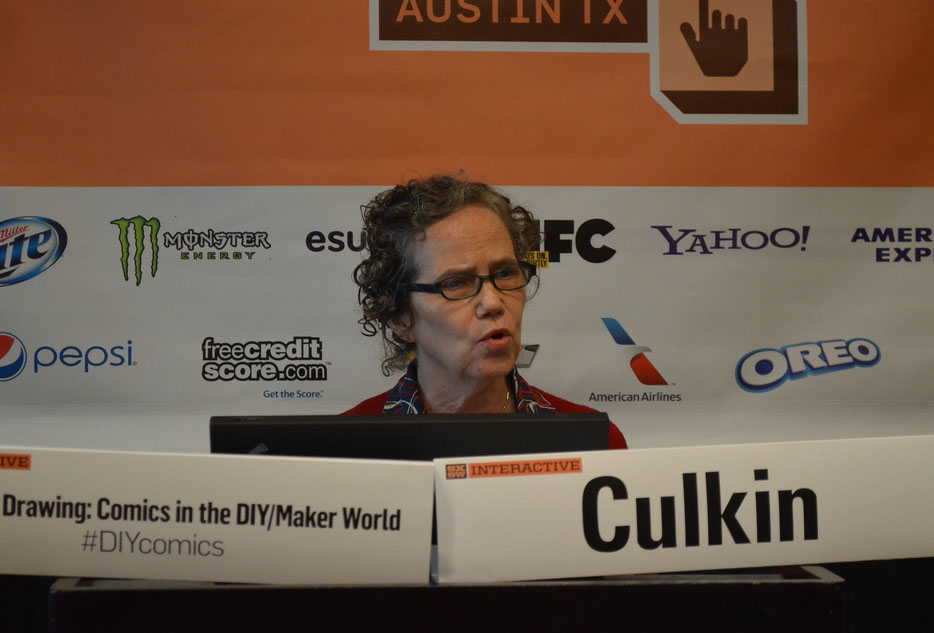
Meet the Maker: Jody Culkin

on

Jody Culkin

Imagine being an artist with an insane desire to learn the tools that would set your art apart, that would inspire you to create something closest to your imagination. Imagine a burning desire improve the lives of others with all the skills that you have. Imagine, being Jody Culkin.

Jody started her career with Technical Photography at the Medical Department of New York University, an art form that is long lost in today’s world of Instagram and digital photography. A course taken on Physical Computing in 1998 at the age of 45 at ITP, NYU to learn electronics and coding, pushed her to be the maker that she is today. She is currently teaching a course in a Community college in New York. She is also an avid sculptor, an artist, a comics maker, a welder and many more things that marks a true maker. An exclusive interview with her here would take you closer to the world of makers.

Priya: What is your oldest memory as a geek and a maker? Also what were the first experiments that got you started in electronics?

Jody: I remember my junior high school days when we were taught about computers yet never got to work on one. Me and my friend used to exchange notes in ASCII art with pencil on paper. Also I had been making small functional objects like a table and lamps.

The first circuits were really simple with a play of many switches. I loved to use switches for so many different things.

Priya: How was the transition from being an artist to an electronics maker? Which, according to you, is the better way to go?
Jody: I think ideas need to be more clearer than only electronics, for that you need to be a designer. Otherwise I see a lot of designers getting help for electronics in the art world.

Priya: I am a huge fan of the Arduino comic strip that you did years back for arduino. What inspired you to do that? Are you working on more such comics?

Jody: Back in 2009, during a summer camp at ITP, I wanted to express whatever I had understood very clearly. So I decided to document it using a comic strip for others too. What you might observe in the comic, is that there is a central character telling the story, it is not only electronics and wires, which is an essential part to make it appealing in any comic.

Yes, I did some work for a breadboard workshop organized by Make. I would also like to do some work on CSS and JavaScript.

Priya: Wait wait.. You code JavaScript?

Jody: Yes, I started with Code Academy, they have some really great lessons to get you started with.

Priya: Impressive! What are the tools, might you suggest to be the essentials for any designer aspiring to add electronics to the art?

Jody: The tools I would suggest are Arduino, Processing, JS, also I liked MAXmsp interface, other random stuff like Digital multimeter, screw driver, basic sensors etc.

Priya: As an artist what are your most commonly used sensors? Also do you have to use general purpose PCBs or get it custom made?

Jody: I use photocells a lot. I also like IR sensors and Force sensitive Resistors, as they are pretty easy to interface. Regarding PCBs, I have always used breadboards. For some reason, they have always held up pretty strong.

Priya: What drives you? And what advice do you have to make it big in the world of Interactive Designs?

Jody: Curiosity drives me. I love putting different stuff together and observing the final results. Like one of my installations is a self turning-pages book, an added functionality of turning the pages via web was interesting.

To be a designer, one should learn to express things in a simple way. A majority of time should be spent working. Apart from that, networking is a must. Try to hang out with the designers whose work you get inspired by. People like to see works of different designers under the same roof. So try to improve your work to get in the grove with them.

Priya: Very insightful. What are your latest works that you would like to talk about these days?

Jody: There was a show at Florida, at the Boca Raton Museum of Art – I had some displays on fashion there. Also had a presentation on the way comics can be used to explain technology. I was working on a Lasersaur build with Eric Hagan, which is an open source laser cutter project started by Nortd labs at ITP at NYU.

Priya: Lastly, how does it feel to be a woman in tech doing electronics and art together? How did it feel back at the university? What is your current passion?

Jody: It feels great and empowering. T, The strength in the university was 50-50 for men and women. However, I observed that the men were putting in more efforts to learn in Physical Computing, whereas the women were more into web development. I wished women participated more. Tom, really supported and guided me well.

Currently, my passion is to teach the diverse students attending the Community College. Yes, some are very well prepared, some are not, but then, that is where a teacher’s true test of creativity lies.

Thank you for your time Jody!

(All of her work has been documented here.)


View the Original article

Sabato si celebra il coworking: Toolbox Festival a Torino

on

Si prepara un fine settimana denso di eventi: a partire dall ‘Arduino Day a Roma, ospitato nella bellissima cornice del Cinema Palazzo, per permettere a chiunque fosse interessato di muovere i primi passi nel mondo di Arduino.  Se invece sabato rimanete tra Torino-Milano-Genova non potete non prendere in considerazione di fare un salto al Festival di Toolbox , vera celebrazione delle tre anime che popolano questo spazio di coworking: la ricchezza della condivisione, l’intraprendenza delle startup e la creatività dei maker e del DIY.

Tante le attività per festeggiare il terzo compleanno del coworking che ospita Fablab Torino: dal workshop di realizzazione di gioielli elettronici del FablabTorino, alla presentazione di Arduino , dai Big Data (Topix)  a come creare la propria campagna di crowdfunding.

Vi aspettiamo tutti lì sabato 6 aprile dalle 10 alle 10!


View the Original article

How to make something like “Makey Makey” using Arduino

on Monday, April 1, 2013

Makey Makey with Arduino

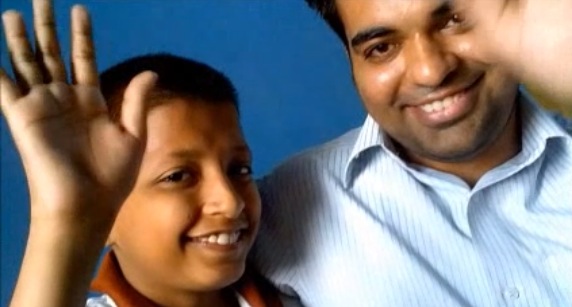
Many people asked Alpesh Vitha how to create something like Makey Makey using Arduino and he created this cool video, together with Mowgli, to share with all of us how to use an Arduino Leonardo to accomplish the task. He lives in Kolkata and  runs a company called “Inventify” to popularize Arduino and science in Indian schools especially those with less resources. Enjoy the video tutorial !


View the Original article

L’Arduino Tour fa tappa a Verona: presentazione + workshop!

on

Verona Arduino tour

Dal 19 al 21 aprile Arduino atterra a Verona e aggiunge una nuova tappa dopo  Matera, Reggio Emilia e Milano.

Il venerdì 19 potrete assistere  alla presentazione pubblica del progetto Arduino e nel weekend due giorni di full immersion per imparare a muovere i primi passi con gli oggetti interattivi.

L’iniziativa è  promossa e ospitata da The Fab e TheCollective e si svolgerà presso TheFab in Vicoletto Valle n. 2, Verona.

I partecipanti al workshop avranno tra le mani e poi si porteranno a casa il nuovo Starter Kit, di cui potete leggere la recensione su Domusweb, così da continuare a casa le sperimentazioni: tutti sono benvenuti al workshop perchè non è richiesta alcuna precedente conoscenza di programmazione o di elettronica.

Se siete della zona intorno Verona questo è il momento di attivarvi e prenotare uno dei posti a disposizione nello shop!


View the Original article

Call for Arduino music at Gwendalyn Festival 2013

on

ArduinoSynth by Collin Mel

(Italian version below)

Are you a musician, music amateur, electronic bricoleur or maker who makes music by creating your own instruments and tools using Arduino?

We are looking for your music tracks to be presented in a radio program entirely dedicated to (DIY) music made with Arduino based synths and instruments.The program is scheduled within the GwenFestival program, an international music and radio festival organized in Chiasso (TI, Switzerland) during April 2013.

Gwenfestival is promoted by Radio Gwendalyn, an on-line independent radio located at Chiasso railway station (during the festival, from April 1st to April 30th, Radio Gwendalyn will use a FM frequency to transmit its music program).

The program will be on air on saturday 13 and sunday 14 April, from 17.30 – 18.00.

How to participate:
Tracks  should include at least an instrument or synth made with Arduino and they will be selected according to few parameters:

- quality of the sound design and music;

- originality of the implemented solution;

- originality of the process or production story.

All genres are accepted.

The program lasts only 1:20 (two episodes of 40 min each), so a limited number of tracks will be selected. However, the list of the excluded tracks will be published  on a public on-line page.

Deadline 10 April 2013

——–

Call for Arduino Synth Music

Sei un musicista, un’amante della musica, un bricoleur elettronico o maker che crea musica con strumenti basati su Arduino?

Allora, inviaci una traccia del tuo progetto musicale per un programma radiofonico dedicato alla musica realizzata con strumenti DIY.

Il programma è inserito nel palinsesto radiofonico del GwenFestival, festival internazionale di musica e radiofonia che avrà luogo a Chiasso (Ticino, Svizzera) durante il mese di aprile 2013. Il festival è promosso da Radio Gwendalyn, radio online indipendente di Chiasso che per solo un mese avrà la possibilità di trasmettere su frequenze radio FM.
Il programma andrà on-air sabato 13 e domenica 14 aprile, dalle 17.30 alle 18.00 su www.radiogwen.ch (on line streaming e podcast) e su FM 107.2 (Lugano) and FM 97.3 (Chiasso).

Ecco i requisiti per partecipare:

Le tracce dovranno includere almeno uno strumento o sintetizzatore DIY basato sulla scheda Arduino. I criteri di valutazione sono:

- qualità del sound design e della musica;

- originalità della soluzione diy implementata;

- originalità del processo di costruzione o altre aspetti connessi alla produzione.

Sono accettati tutti i generi musical (dall’elettronica alla musica country).

Il programma dura circa un’ora e venti minuti ed è diviso in due puntate, quindi, sarà accettato solo un numero limitato di tracce.

Le tracce non selezionate saranno inserite in una lista pubblicata on-line.

Per inviare la propria traccia, basta completare il modulo pubblicato su questa pagina.

Scadenza 10 Aprile 2013


View the Original article

How close are we to doomsday? A clock is calculating it in real time

on

neurotic armageddon by tom schofield

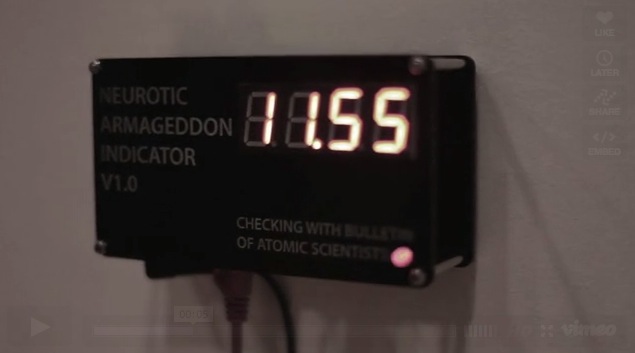
Tom Schofield created an installation artwork which visualises the ‘Doomsday Clock’, a symbolic clock maintained by an academic journal, ‘The Bulletin of Atomic Scientists’ which:

conveys how close humanity is to catastrophic destruction–the figurative midnight–and monitors the means humankind could use to obliterate itself. First and foremost, these include nuclear weapons, but they also encompass climate-changing technologies and new developments in the life sciences that could inflict irrevocable harm.

The artwork is composed by two pieces:

  • a small computer programme running on a server which ‘scrapes’ the content of the bulletins home page as often as possible. The software checks the current status of the clock and then sends the results over the internet
  • a small wall clock which receives data and displays the time of the Doomsday Clock on a red LED clock display. This process repeats as fast possible so that the device shows in near-real-time the status of the doomsday clock. 

The project uses an Arduino Uno board and an Arduino Ethernet shield and the clock is controlled with a MAX7219 Led control chip. Tom published  all the code and design for the indicator in his Github code repo  and told us he’s  very interested in the possibility that other people might make their own indicators. So, don’t be shy and give it a try!


View the Original article

Kids and parents discovering the wonders of 3d printing

on

tinkercad codemotion

Last weekend Arduino and Officine Arduino participated to  the third edition of Codemotion Rome, the international event focused on the art of programming.

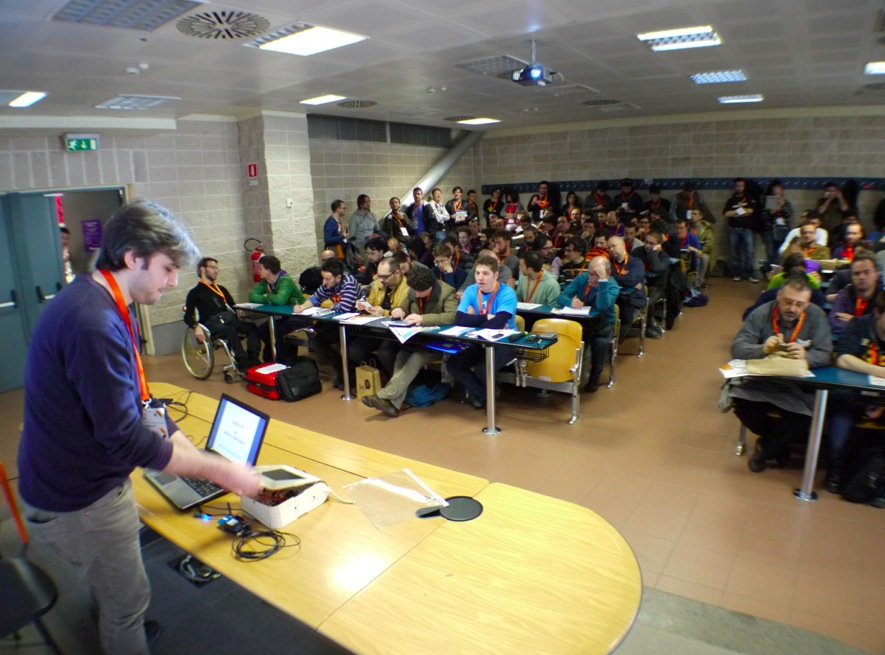
During the three-day event we organized presentations and lab sessions: Federico Vanzati gave a great talk on the Internet of Things world and the new Arduino Gsm Shield, plus a live coding session on how to use it; then Davide Gomba introduced Processing using the Arduino Esplora as a controller to code and play Pong videogame.

arduino gsm shield presentation

In this creative context the activity that left us with more intense memories has been the 3d printing workshop involving kids an parents into experimenting for the first time the excitement of transforming bits into atoms.

As you can see from the pictures below, kids (with the help of their geek parents) after understanding the basics of the cloud-based 3d app Tinkercad, started creating their virtual objects. Later on the Kentsrappers  team and mister Slic3r with their own 3d printers showed them how, layer by layer, any 3d file could be materialized into an object.

It’s a pity that a couple of days ago Tinkercad announced the closure of the platform, but we hope their new project is going to be as cool as this in involving newbies into the 3dprinting revolution!


View the Original article